
- Share:
-

-

-

-


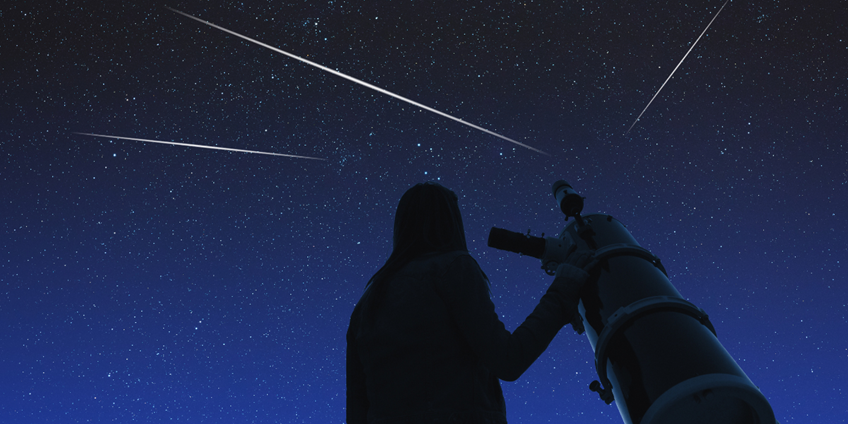
What if we could stop an asteroid before it ever reached Earth? Thanks to NASA, that’s becoming a reality.
Asteroids crashing into Earth may sound like something straight out of a science fiction movie, but history tells a different story. Throughout our planet’s history, asteroid impacts have changed life on Earth in remarkable ways.
About 66 million years ago, a six-mile-wide asteroid slammed into Earth, triggering the extinction of the dinosaurs and roughly 75% of all living species. Then, in 1908, a much smaller asteroid exploded above Siberia during what became known as the Tunguska Event. Even though it never struck the ground, the explosion flattened more than 800 square miles of forest with the force of approximately 1,000 Hiroshima bombs.
Fortunately, scientists aren’t waiting for the next asteroid to appear. Every day, NASA monitors the skies, tracks potentially hazardous objects, and develops new ways to protect our planet.
Let’s explore how engineers and scientists are working together to defend Earth from cosmic threats—and why their work continues to inspire the next generation of innovators.
How NASA Tracks Near-Earth Asteroids
The first step in protecting Earth is knowing what’s out there.
NASA constantly monitors Near-Earth Objects (NEOs), including asteroids and comets whose orbits bring them close to Earth’s path around the Sun.
The agency’s Center for Near-Earth Object Studies (CNEOS) coordinates this ongoing search by combining observations from powerful ground-based telescopes and space observatories. These instruments scan the night sky for objects moving against the background of distant stars.
One of NASA’s most successful asteroid hunters has been the NEOWISE space telescope, which has helped discover thousands of Near-Earth Objects. Looking ahead, NASA’s NEO Surveyor mission is designed to use infrared technology to detect asteroids that are difficult for existing telescopes to spot.
Finding these objects early gives scientists valuable time to determine whether they pose any risk—and, if necessary, begin planning how to redirect them.
A Historic Test of Asteroid Deflection
Tracking asteroids is only half the challenge. The next question is: What happens if one is actually headed toward Earth?
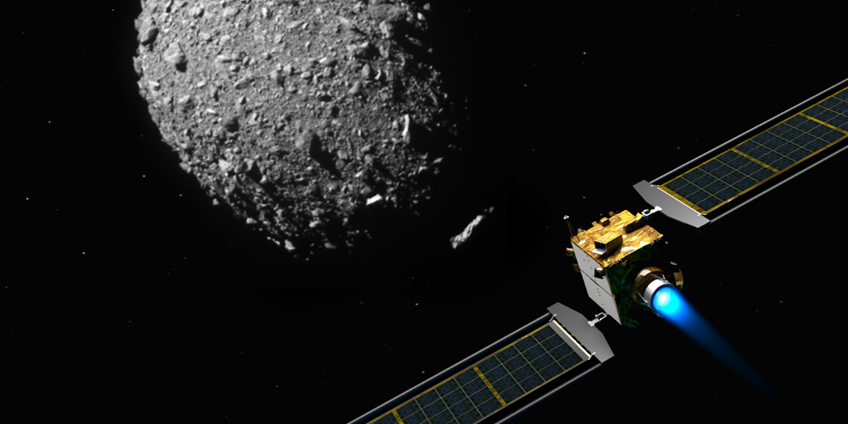
NASA answered that question in September 2022 with the Double Asteroid Redirection Test (DART), the world’s first planetary defense mission.
The idea was surprisingly simple: use a spacecraft to gently change an asteroid’s path by intentionally crashing into it.
NASA targeted Dimorphos, a small moon orbiting the larger asteroid Didymos. Since neither asteroid threatened Earth, they made the perfect testing ground.
Traveling at nearly 14,000 miles per hour, DART successfully struck Dimorphos and shortened its orbit by 32 minutes, exceeding scientists’ expectations.
It was the first real demonstration that humans can intentionally change an asteroid’s path, giving us an entirely new way to protect our planet in the future.
What’s Next for Planetary Defense?
NASA isn’t stopping with DART.
Building on the mission’s success, the European Space Agency launched the Hera mission to study the impact site and learn exactly how DART changed Dimorphos. When Hera reaches the asteroid system in 2027, scientists will gather valuable information about its structure, composition, and how it responded to the collision.
Researchers are also exploring additional ways to protect Earth, including:
- Gravity tractors, where a spacecraft slowly uses its own gravitational pull to nudge an asteroid off course.
- Nuclear deflection, considered only as a last resort for extremely large asteroids discovered with little warning.
Every mission helps scientists better understand how to prepare for future challenges.

Engineering Is at the Heart of Planetary Defense
Protecting Earth from asteroids isn’t the work of one scientist or one engineer. It takes teams of aerospace engineers, astronomers, computer programmers, physicists, mathematicians, and mission planners working together to solve incredibly complex problems.
Every spacecraft, telescope, computer simulation, and mission plan begins with a simple question:
“How can we solve this problem?”
That’s exactly the kind of thinking engineers use every day.
Today’s students who love building, designing, coding, or exploring space could one day help lead the next generation of planetary defense missions.
Why Planetary Defense Matters
While the chances of a large asteroid impacting Earth are extremely small, scientists know that preparation is one of the best ways to keep our planet safe.
By studying asteroids, tracking their paths, and developing new technologies to redirect them if necessary, space agencies around the world are solving problems long before they become emergencies. These efforts also lead to advances in engineering, robotics, materials science, and space exploration that benefit future missions beyond planetary defense.
Most importantly, this work reminds us that curiosity, innovation, and collaboration can solve some of the biggest challenges imaginable—even protecting an entire planet.
Think Like a NASA Engineer with Engineering For Kids
Have you ever wondered what it would be like to design rockets, build robots, or plan a mission to another planet?
Engineering For Kids gives young innovators the chance to experience many of the same engineering concepts NASA teams use every day. Through hands-on STEM activities, students tackle exciting challenges involving rocket design, Mars habitat construction, robotics, and problem-solving while learning the science behind real space exploration.
Whether they’re designing spacecraft, programming robots, or testing new ideas, children build the same critical thinking and creative problem-solving skills that engineers use to tackle real-world challenges.
Who knows? The next child inspired by space exploration could one day help design NASA’s next planetary defense mission, develop new technologies for deep-space travel, or become one of the engineers solving tomorrow’s biggest challenges.